Grip Strength: The Simple Number Researchers Keep Paying Attention To
How hard you can squeeze turns out to say a lot about overall strength and health as you age. What the research found, what it doesn't mean, and how to keep your grip strong.
You don't need a gym membership or a complicated programme. Four basic movement patterns cover most of what keeps a man strong, steady and independent.

Muscle is the quiet asset of later life. It's what gets you out of a low chair, up a flight of stairs with the shopping, and back on your feet if you trip. And unless you use it, you lose it: after middle age, adults gradually lose muscle mass and strength, and the loss tends to speed up in the 60s and 70s.
The encouraging part is that muscle responds to training at any age. Studies of people well into their 70s and 80s show strength gains within weeks of starting. You don't need a complicated programme. You need a few basic movements, done regularly, with real effort.
The Physical Activity Guidelines for Americans, published by the U.S. Department of Health and Human Services and summarised by the CDC, recommend that adults do muscle-strengthening activities at least two days a week, working all the major muscle groups: legs, hips, back, abdomen, chest, shoulders and arms. That's on top of 150 minutes a week of moderate activity such as brisk walking. Older adults are also advised to include balance training.
Four movement patterns cover almost all of it.
This is the most practical strength exercise there is, because you do it dozens of times a day.
Make it easier: use a higher seat or your hands. Harder: a lower seat, hold a weight at your chest, or progress to a full squat.
Pushing strength helps you get up off the floor and push yourself up from a fall.
Progress by using a lower surface over the weeks: wall, then counter, then a sturdy bench, then the floor.
Pulling muscles support your upper back and posture, and they're the ones desk jobs and screens neglect most.
No band? Use a dumbbell or a full water jug: support one hand on a bench, let the weight hang, and pull it toward your hip.
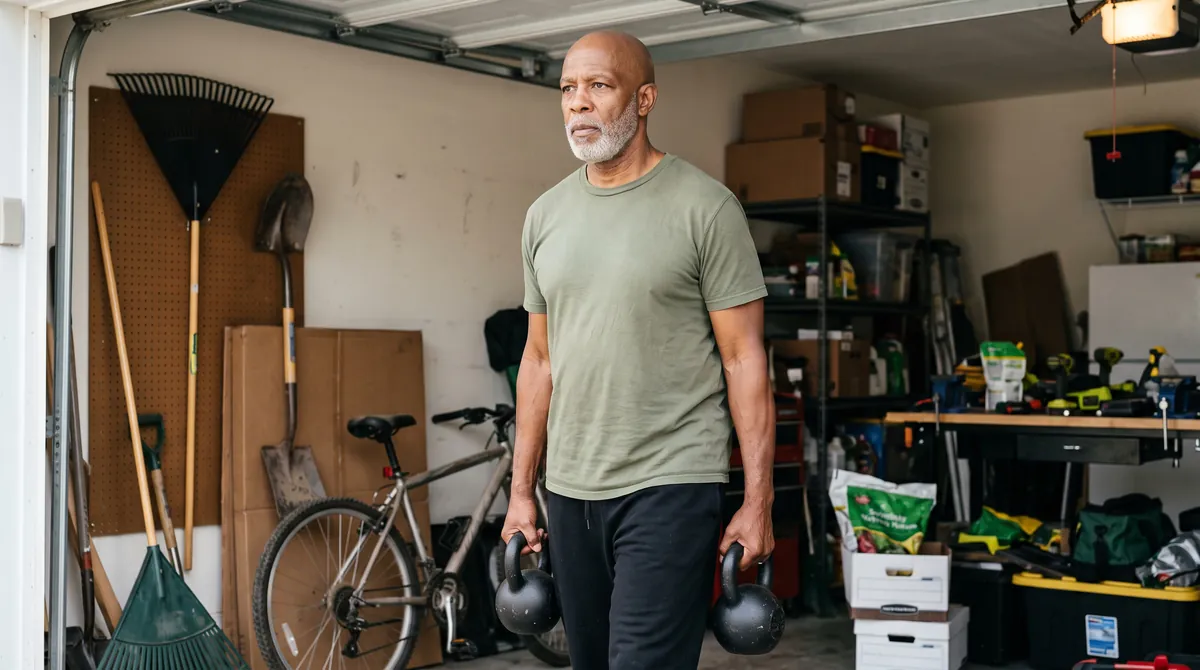
Carrying trains your grip, shoulders, core and legs all at once, and it's the most "real life" move on the list.
Carrying also builds grip strength, which researchers have found to be a surprisingly telling health marker. More in our article on grip strength.
| Move | Sets | Reps / time |
|---|---|---|
| Sit-to-stand | 2–3 | 8–12 |
| Incline push-up | 2–3 | 8–12 |
| Row | 2–3 | 8–12 each side |
| Farmer's walk | 2–3 | 30–60 seconds |
Do this on two or three non-consecutive days a week. Choose an effort where the last two or three repetitions of each set feel genuinely hard but your form stays clean. When 12 repetitions start to feel easy, make the move harder.
One page to take to your next appointment: the screenings, numbers and questions worth raising after 50, with space to write your results. Made to print.
We'll email you a link to confirm your address; confirming opens the download. You'll also get our occasional newsletter on strength, sleep and men's health. Unsubscribe anytime. We never sell your email address. See our Privacy Policy.
Check your inbox. We sent a message to confirm your address. Click the button in it and the checklist opens right away. Not there in a few minutes? Look in your spam or promotions folder.
How hard you can squeeze turns out to say a lot about overall strength and health as you age. What the research found, what it doesn't mean, and how to keep your grip strong.

Waking up to use the bathroom is one of the most common complaints of men over 50. The prostate is only one of several reasons, and the fix depends on which one is yours.

Most men see a doctor when something hurts. A short list of the screenings, numbers and questions worth raising after 50, based on U.S. Preventive Services Task Force recommendations.